
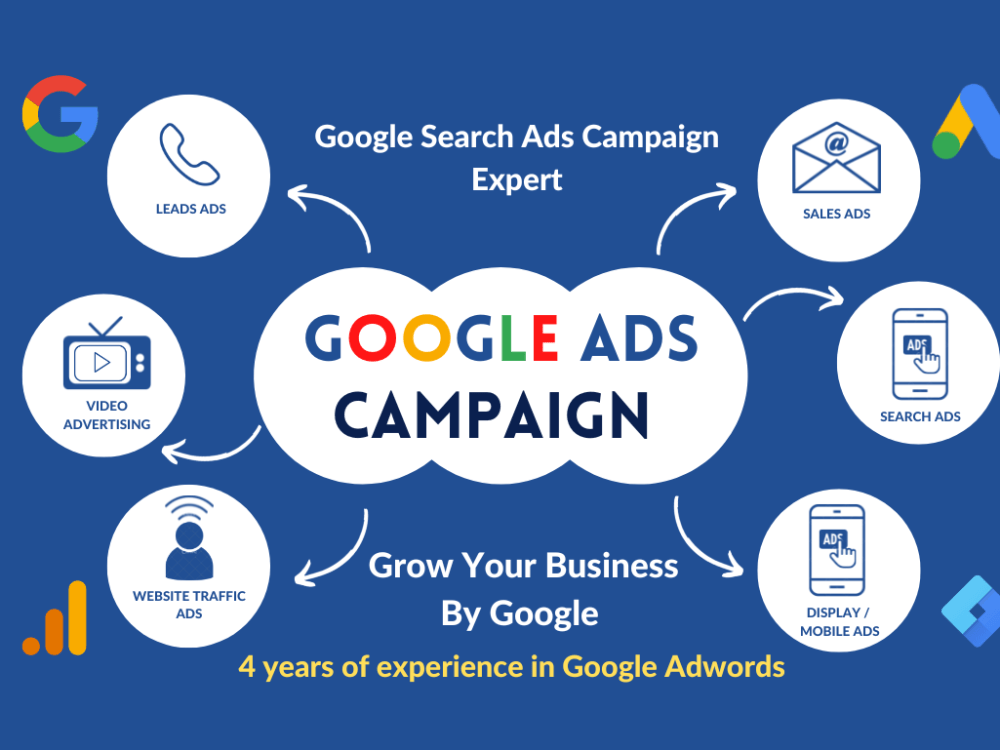
In today’s competitive online world, businesses cannot rely only on social media posts or SEO. If you want instant visibility, targeted traffic, and measurable results, you must understand the power of Google Ads in Digital Marketing.
Whether you’re a student, business owner, freelancer, or marketing professional, this complete guide will help you understand how Google Ads works, why it matters, and how to use it effectively.
Let’s dive in 👇
What is Google Ads?
Google Ads is an online advertising platform developed by Google that allows businesses to display ads across Google’s vast network.
These ads can appear on:
- Google Search results
- Partner websites
- Mobile apps
- Gmail
- YouTube
In simple words:
You pay → Your ad appears in front of the right audience → You get clicks, leads, or sales.
Why Google Ads is Important in Digital Marketing
Digital marketing has two major approaches:
- Organic Marketing (SEO, content marketing, social media growth)
- Paid Marketing (Google Ads, social media ads, display ads)
While SEO takes time (3–6 months for visible results), Google Ads delivers instant traffic.
Here’s why Google Ads in digital marketing is powerful:
- Immediate online visibility
- Targeted audience reach
- Scalable campaigns
- Measurable ROI
- Competitive advantage
If used correctly, it can generate high returns even with a small budget.
How Google Ads Works
Google Ads operates on an auction-based system.
When someone searches for a keyword like:
“best digital marketing course”
Google checks:
- Who is bidding on this keyword
- The bid amount
- Ad quality score
- Relevance of the landing page
The best combination wins the top position.
Key Factors That Determine Success:
- Keyword selection
- Bid strategy
- Ad relevance
- Quality Score
- Landing page experience
- Expected click-through rate (CTR)
It’s not just about paying more — it’s about being more relevant.
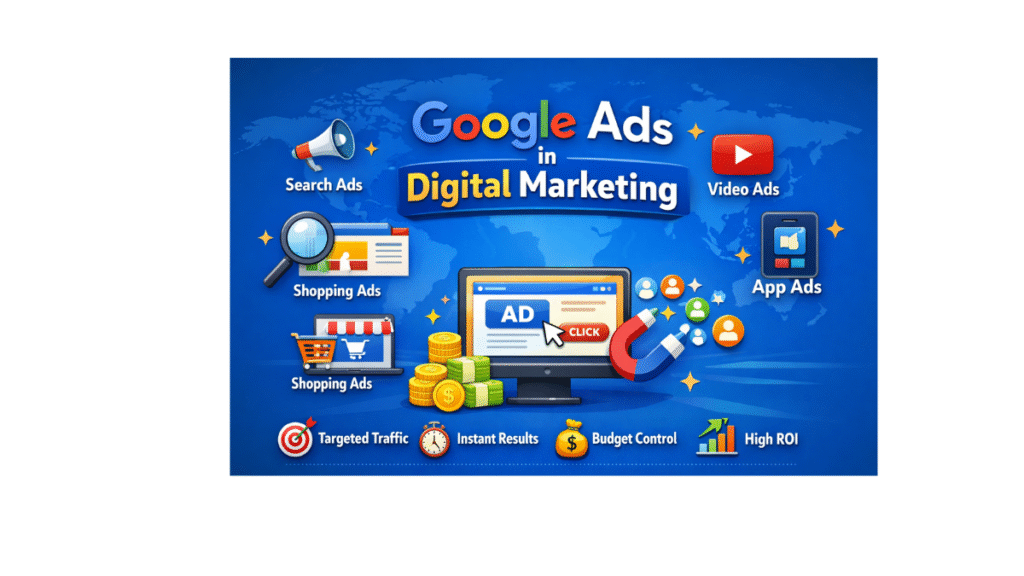
Types of Google Ads Campaigns
Understanding campaign types is essential when learning Google Ads in digital marketing.
1. Search Ads
Text-based ads that appear on Google search results when users type specific queries.
Best for:
- Lead generation
- Service-based businesses
- High-intent buyers
2. Display Ads
Image or banner ads shown on websites within Google’s display network.
Best for:
- Brand awareness
- Retargeting
- Visual promotions
3. Video Ads
Video ads shown primarily on YouTube.
Best for:
- Product demonstrations
- Brand storytelling
- Engagement campaigns
4. Shopping Ads
Product-based ads showing image, price, and store details.
Best for:
- E-commerce businesses
5. App Campaigns
Designed to promote mobile app installs and engagement.
Benefits of Google Ads in Digital Marketing
Let’s make this interactive.
Ask yourself:
- Do you want instant traffic?
- Do you want to target specific cities?
- Do you want measurable results?
- Do you want full budget control?
If your answer is YES — Google Ads is for you.
Major Benefits:
✔ Instant Results
Campaigns start delivering traffic as soon as they go live.
✔ Advanced Targeting
Target users by:
- Location
- Age
- Gender
- Interests
- Device
- Time of day
✔ Budget Flexibility
You can start with as little as $5–$10 per day.
✔ Performance Tracking
Every click, impression, and conversion can be tracked.
✔ High ROI Potential
When optimized properly, Google Ads can deliver strong returns.
How Much Budget Do You Need?
Budget depends on:
- Industry competition
- Keyword cost-per-click (CPC)
- Geographic location
- Campaign objective
Some keywords cost $0.20 per click.
Highly competitive industries (like insurance or legal services) may cost $10–$50 per click.
For beginners:
- Start small
- Test campaigns
- Optimize regularly
Step-by-Step Guide to Launch Google Ads
Here’s a simplified roadmap:
Step 1: Define Your Goal
Choose your objective:
- Website traffic
- Leads
- Sales
- Brand awareness
Step 2: Conduct Keyword Research
Focus on:
- High-intent keywords
- Low competition opportunities
- Long-tail keywords
Step 3: Create Compelling Ad Copy
Your ad must:
- Solve a problem
- Highlight benefits
- Include a strong CTA
Examples:
- “Enroll Now”
- “Get Free Consultation”
- “Shop Today”
- “Claim Your Offer”
Step 4: Design a High-Converting Landing Page
Even the best ad fails if the landing page is poor.
Make sure your page:
- Loads fast
- Is mobile-friendly
- Has clear CTA
- Builds trust
Step 5: Set Up Conversion Tracking
Without tracking, you are guessing.
With tracking, you are optimizing.
Common Mistakes to Avoid
Even experienced marketers make mistakes.
Avoid these:
❌ Targeting broad keywords
❌ Ignoring negative keywords
❌ Not optimizing landing pages
❌ Running ads without tracking
❌ Stopping campaigns too early
Advanced Strategies for Better Results
Once you understand basics, move to expert-level techniques:
🔹 Remarketing
Show ads to users who already visited your website.
🔹 A/B Testing
Test different headlines, descriptions, and CTAs.
🔹 Smart Bidding
Use automated bidding strategies powered by machine learning.
🔹 Audience Segmentation
Create custom audiences for better targeting.
Google Ads vs SEO: Which is Better?
| Feature | Google Ads | SEO |
| Speed | Instant | Slow |
| Cost | Paid | Organic |
| Long-term impact | Medium | High |
| Control | High | Limited |
Best strategy?
👉 Combine both for maximum growth.
Who Should Learn Google Ads?
- Students entering digital marketing
- Business owners
- Freelancers
- Marketing professionals
- Agencies
- Startup founders
Google Ads skills are highly demanded worldwide.
The Future of Google Ads in Digital Marketing
With AI and automation improving rapidly:
- Smart campaigns are becoming more powerful
- Data-driven targeting is improving
- Automation reduces manual effort
- Performance-based optimization is increasing
The future belongs to marketers who understand data, targeting, and strategy.
Final Thoughts
Google Ads in Digital Marketing is not just a paid advertising tool — it’s a growth engine.
When used strategically, it can:
- Drive consistent traffic
- Generate qualified leads
- Increase brand awareness
- Boost revenue
- Scale businesses faster
If you want faster results in the digital world, mastering Google Ads is no longer optional — it’s essential.